Conference on Learning and Student Success
Pre-Conference Workshops
Make The Most of Your Conference Experience
Kick off your 2026 CLASS experience with a hands-on, interactive workshop. Facilitated by leading experts, pre-conference workshops offer a “deep dive” into key topics related to the conference.
All pre-conference workshops will take place in person on Thursday, April 16, 2026, and require separate registration.
Cost:
$275/Member
$350/Nonmember
Morning Workshops
8:00–11:00 a.m. MST
Workshop 1
Finding Your Marketing Courage as a Non-Marketer
Marketing your program’s or unit’s work doesn’t have to be intimidating—even if you’re not a communications professional. This interactive workshop equips participants with practical tools, strategies, and confidence to navigate marketing and communications within their institutions and units. Participants will learn core marketing fundamentals, explore how to balance institutional brand guidelines with unit-level needs, and develop approaches for sharing their work clearly and effectively.
Through examples, group discussion, and hands-on exercises, participants will practice telling their unit’s story in ways that resonate with key audiences, even with limited time or resources. The session emphasizes realistic, adaptable strategies that help non-marketers communicate impact, build visibility, and advocate for their work with clarity and purpose.

Faith Casey
Social Media Intern, Virginia Tech
Jennifer Hart
Professor and Chair of the History Department, Virginia Tech

Andrea Huggins
Senior Director of Marketing, AAC&U

Cammie Sgarrella
Academic Coordinator and Communications Specialist, Virginia Tech
Workshop 2
Student Success by Design: A Framework for Institutional Impact
Student success today depends on intentional design across the full student experience, not isolated programs or offices. In this interactive workshop, campus teams and decision influencers will explore how affordability, advising, teaching, technology, and career readiness can be aligned into a cohesive, institution-wide approach. Participants will work with a flexible student success framework and examine expanded definitions of success—including retention, learning, belonging, and career outcomes—to understand how they can shape strategy and drive measurable impact.
Through guided exercises, case examples, and peer collaboration, participants will design or refine approaches that bridge academic and student affairs, balance technology with human support, and embed equity and affordability throughout the student journey. Participants will leave with a practical, quick-start roadmap and tools for building cross-campus coalitions, strengthening shared accountability, and translating shared commitment into coordinated, sustainable action.
Shonda Goward
Interim Associate Vice Chancellor for Student Success, California State University
Dilcie Perez
Vice Chancellor of Strategic Enrollment Management and Student Success, California State University
Workshop 3
Assignment Innovation Lab: AI Tools Meet VALUE Assessment
This hands-on lab explores how artificial intelligence can be used thoughtfully to strengthen alignment among learning outcomes, assignments, and assessment. Participants will examine how generative AI tools—such as ChatGPT, Claude, and Gemini—can serve as collaborative thought partners in assignment and rubric design, whether for their own courses or in support of faculty and program-level goals. Grounded in a lens of courageous care, the lab emphasizes innovation that prioritizes student learning, equity, and educational quality.
Centering on the integration of AI with AAC&U’s VALUE (Valid Assessment of Learning in Undergraduate Education) rubrics, participants will engage in guided, applied work to analyze and redesign assignments, map them to VALUE rubrics, and scaffold assessments to better support student development. Alongside hands-on design activities, participants will critically examine ethical considerations, equity implications, and the continuing importance of human judgment in assessment. Participants are encouraged to bring their own assignments and rubrics to leave with clearer alignment, refined tools, and practical strategies for more transparent and meaningful assessment.

Jessica Chittum
Assistant Vice President for Curricular and Pedagogical Innovation and Director of VALUE Operations, AAC&U
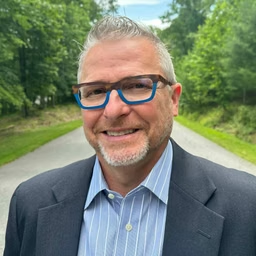
C. Edward Watson
Vice President for Digital Innovation, AAC&U
Workshop 4
Intentional Assignment Design: Bridging What Students Learn, How We Assess, and How We Teach
This interactive workshop helps participants address a common challenge in higher education: misalignment among learning outcomes, assessments, and teaching activities. Using a replicable framework for intentional assignment design, participants will explore how to create assignments that authentically connect what students learn, how their learning is assessed, and how instruction is structured—supporting both student learning and program- and institution-level assessment.
Grounded in backward design and Fink’s Integrated Course Design principles, participants will work through a complete assignment (re)design process they can immediately apply with colleagues on their own campuses. Through hands-on practice with AAC&U VALUE rubrics, TILT (Transparency in Learning and Teaching) principles, and the VALUE ADD tool, participants will examine a concrete example of successful redesign and apply the framework to their own assignments. Participants will leave with redesigned materials and a practical process for leading intentional assignment design and alignment work across their institution.
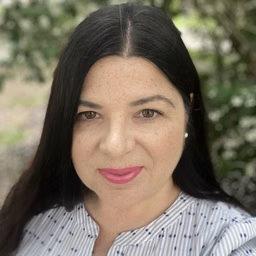
Ligia Pamfilie
Instructional Designer, AAC&U
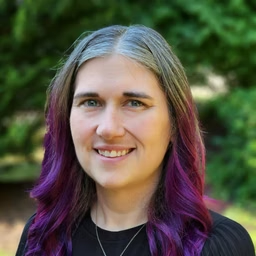
Beth Perkins
Assistant Director for Research and Assessment, AAC&U

Anabel Livengood
Senior Educational Developer, Western Carolina University
Afternoon Workshops
12:00–3:00 p.m. MST
Workshop 5
Gen Ed & AI: The Potential Power and Pitfalls of AI as a Curricular Considerations, Pedagogical Strategy, and Emerging Learning Outcome
This interactive, hands-on workshop explores how generative AI can be used to strengthen general education curricula and assessment while thoughtfully addressing its risks and responsibilities. Drawing on insights from the new second edition of Teaching with AI: A Practical Guide to a New Era of Human Learning, participants will examine the evolving AI landscape, including issues of academic integrity, ethics, and curricular change, with a focused emphasis on pedagogical and assessment strategies that support general education learning outcomes.
Participants will explore how AI tools such as ChatGPT, Gemini, and Claude can be leveraged in alignment with AAC&U’s VALUE (Valid Assessment of Learning in Undergraduate Education) initiative to support student learning and assessment, with particular attention to AI literacy, critical thinking, and written communication. Guided discussions and applied examples will equip participants with concrete, responsible strategies for integrating AI into general education programs in ways that enhance learning, strengthen assessment practices, and respond to emerging institutional priorities.

Caleb J. Keith
Assistant Vice President for Digital Initiatives, AAC&U
C. Edward Watson
Vice President for Digital Innovation, AAC&U
Workshop 6
Embarking on Gen Ed Reform with Lessons from the Cornerstone: Learning for Living Initiative
This examines how institutions can approach general education reform by drawing lessons from the Teagle Foundation’s Cornerstone: Learning for Living initiative. Launched to reinvigorate the role of the humanities in general education, the initiative seeks to broaden student access to transformative humanities learning, foster belonging and community, strengthen the coherence of general education, and expand teaching opportunities for humanities faculty. Now involving more than 85 campuses nationwide, Cornerstone offers a rich set of insights into designing integrative, mission-driven general education experiences.
Facilitated by Teagle Foundation leadership and featuring academic leaders from participating two- and four-year institutions, the workshop will explore curricular, structural, political, and pedagogical dimensions of general education reform. Participants will learn how campuses have built faculty and administrative buy-in, strengthened teaching and learning through transformative texts, and sustained reform over time. The session will conclude with practical guidance on developing competitive concept papers for the Cornerstone: Learning for Living grant initiative.
Through generous funding from the Teagle Foundation, CLASS attendees may register for this workshop at no cost (limited to 50 registrants.)

Wesley Beal
W.C. Brown, Jr., Professor of English, Lyon College

Harold Braswell
Associate Professor, Graduate Program Director and Bicentennial Fellow, Department of Health Care Ethics, Saint Louis University
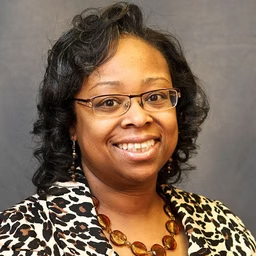
Rhonda M. Collier
Assistant Vice President of Academic Enhancement and Leadership Development, Office of the Provost and Vice President of Academic Affairs, Alabama State University

Amy Parsons
Professor of English, Cal Poly Maritime Academy

Loni Bordoloi Pazich
Senior Program Director for Institutional Initiatives, The Teagle Foundation
Workshop 7
There Is No Magic: Institutional Transformation by Design
Transforming the undergraduate experience requires intentional design rather than wishful thinking. This workshop demystifies how institutions can lead sustainable campus change—from general education reform to the implementation of high-impact practices and the reimagining of assessment—by centering faculty expertise and engaging students as meaningful partners in the work.
Participants will explore a practical, efficient, and affordable framework for institutional transformation that addresses today’s accountability landscape, including regional accreditation, state mandates, and emerging federal requirements. Drawing on examples from diverse institutional contexts, the workshop highlights strategies for moving beyond compliance-driven assessment toward practices that genuinely improve teaching and learning, ensuring that high-impact practices advance equity and excellence. Participants will leave with actionable tools and renewed confidence to build campus buy-in, leverage existing resources, and lead meaningful, lasting change by design.
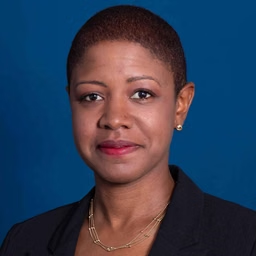
Amy Johnson
Associate provost for undergraduate education, Old Dominion University

Kate Drezek McConnell
Vice President for Curricular and Pedagogical Innovation and Executive Director of VALUE, AAC&U
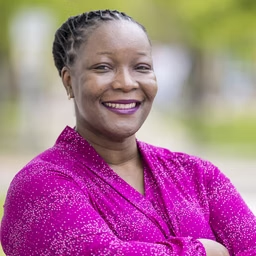
Bethany Miller
Associate Provost & Chief Data Officer, Macalester College