
The Happy Translator
Stephanie McCarter views Latin classics through a twenty-first-century feminist lens
⚠️ You have free article remaining.
Log in or become a member for unlimited access.
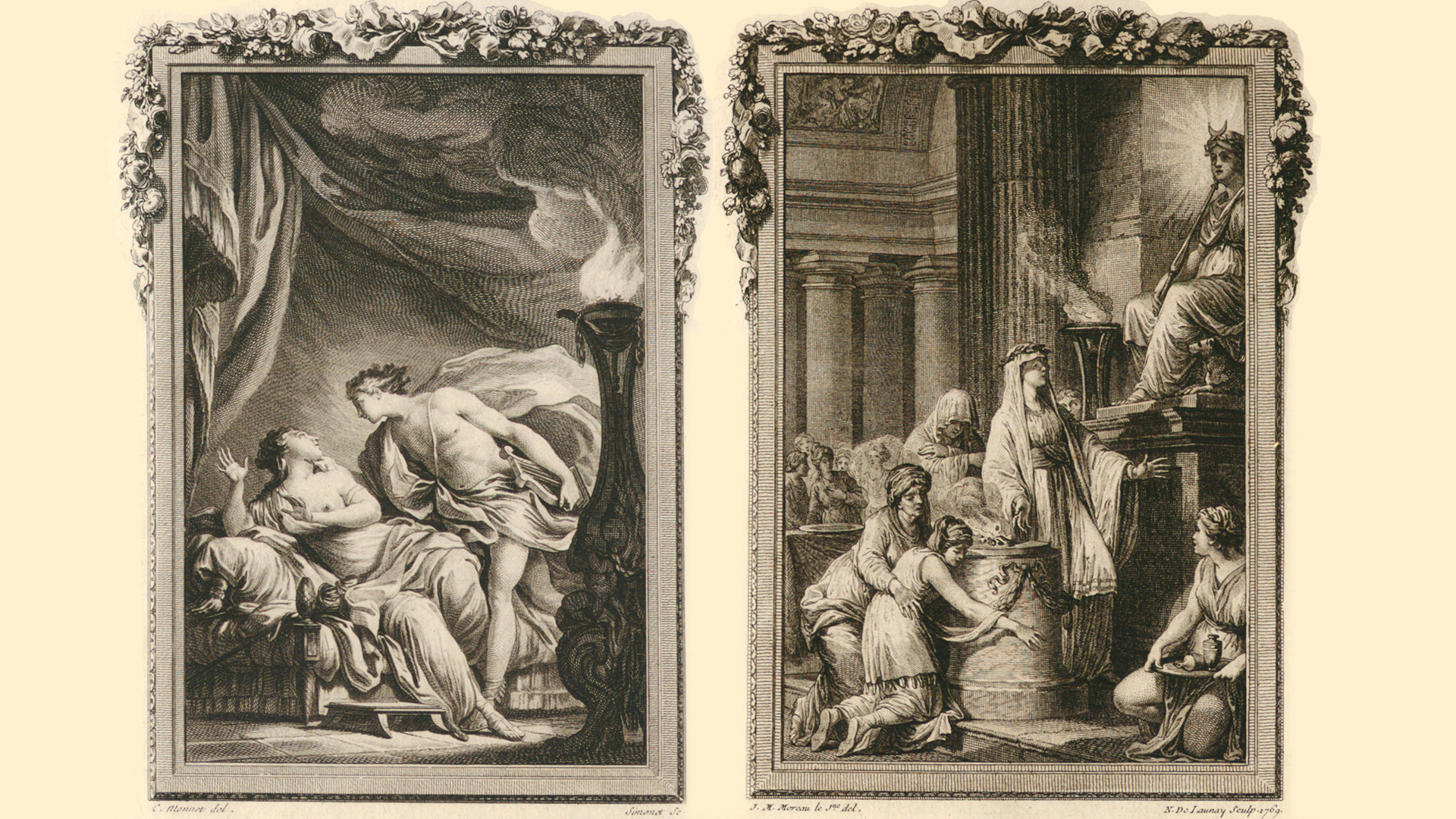
As stories of sexual harassment and violence dominated headlines during the 2017 #MeToo movement, classics professor Stephanie McCarter focused on issues of translation. In an essay for Electric Literature, a quarterly journal that amplifies social justice issues, McCarter rebukes previous translators of Roman poet Ovid’s Metamorphoses for mitigating, obscuring, and erasing the fifty separate instances of rape in the epic poem. “These translations echo our failure to trust women who say they have been raped, and they reenact how we downplay female victimization while exonerating male perpetrators,” writes McCarter, who teaches at the University of the South.
To illustrate her point, McCarter analyzes poet Rolfe Humphries’s 1960 translation of a story from Book Four of Metamorphoses in which the Sun god rapes the young Persian princess Leucothoë. Humphries translates vim passa est as Leucothoë having been “won over” by the Sun as he “took his passion” while she uttered “no complaint.” Such language, McCarter asserts, incorrectly depicts the rape as a consensual sexual act and obfuscates the actual events. Instead, McCarter translates vim passa est as “endured his force” and describes Leucothoë as “panicked” and “conquered.”
In her essay, McCarter asks readers to consider why translators have obscured Leucothoë’s rape. “It is irresponsible, especially in our present moment, to overlook rather than interrogate the epic’s sexual violence,” she writes. Only one woman, Mary M. Innes, had ever published an English translation of the epic. “Perhaps it’s the right time for another woman to be given a try,” McCarter suggests.
McCarter’s words proved prophetic. Soon after her essay appeared in Electric Literature, an editor at Penguin Classics contacted her about publishing a new translation of a major Latin epic. McCarter accepted the challenge, and in 2022, Penguin released her translation of Metamorphoses. McCarter’s approach to this translation reflects philosopher Walter Benjamin’s assertion in “The Task of the Translator” that “all translation is interpretation”—meaning that when translating a text, translators do not simply convey literal meaning but rather interpret the text’s deeper implications, thus adding their personal understanding of the work to the translation. To that end, McCarter employs an accessible style, a conversational tone, and intentionally uses feminist language and contemporary terms like “gender-fluid.”
In the following conversation with Liberal Education, McCarter reflects on the importance of foreign language study, the role of feminism in her work, and the joy she finds in the art of translation.
What drew you to the field of translation?
I never considered becoming a translator until I had young children. My time became precious, and I had to carefully decide how to use it. I asked myself, “What’s the biggest challenge I have in the classroom?” I needed a translation of Horace’s poetry that worked for the way I teach—one that was both poetically beautiful and close to the original Latin. I began by translating his “Cleopatra Ode.” I had never experienced such pleasure in my work! I am a very happy translator. That’s not only motivated me to take on more work, but it’s also made me a happier person.
There are many translations of Ovid’s Metamorphoses. How does your translation differ from the ones that have gone before it?
I aimed for greater clarity and accessibility. That’s important both as a pedagogical tool and for reaching general audiences. I also take a different approach from earlier translators in the ways I scrutinize themes of sexual violence, gender, and the body.
Your translations are often praised for taking a feminist approach. What role does feminism play in your work? How do you define feminism?
I define feminism as the belief that woman are fully human complex moral agents who have the right to pursue their work and make their own choices. In terms of translation, feminism became a valuable framework for me following the #MeToo movement’s emphasis on the importance of accurately describing sexual violence—too often we use euphemisms like “he had his way with her” or we leave the perpetrators out completely. For example, a translator titles a story “The Rape of Persephone” rather than “Pluto Rapes Persephone.”
Ultimately, utilizing a feminist lens allows me to arrive at a more accurate and stronger understanding of the Latin. It helps me examine how gender, power dynamics, and the body work across the entire epic. I’ve come to understand that the body is not essentially gendered one way or another but, rather, that gendering the body happens culturally. Ovid was already attuned to that—modern feminist theory has helped me see that as well.
You are only the second woman to translate Metamorphoses. Does the gender/identity (race, ethnicity, religion, etc.) of the translator matter? How does it influence the translation?
Yes, it matters. My personal experiences as a woman informed my thinking about the text as did the cultural moment in which I live. But as a cisgendered White person, I may lack the experiences to fully grasp all the gender nonconformity and other qualities in the text. I hope other translators will come along who will see new things in the text that my background did not enable me to see.
Does the identity of the translator affect how readers receive a translation?
Yes! There’s often an expectation that a female translator has an explicitly feminist agenda and that she will alter the text to fit that agenda. We do not make those assumptions with men, even though previous male translators of Ovid assumed that the poet had a heterosexual male view of the world, and that influenced their interpretation of the text—all translators have biases.
Given what you’ve said about how identity influences translation, how can we create a more diverse pool of translators?
Classics remains an elite field dominated by male translators. Embracing translation itself more broadly within the field would help change this. Traditionally, the academy has seen translation as something to do in one’s retirement or as an extra on top of more traditional research. Institutions have not valued translation as an important interpretive tool that can advance our knowledge of a text and reveal new things about the ancient world. Publishers proactively reaching out to translators from different backgrounds would help. We should also actively engage students in evaluating translations and provide opportunities for them to translate texts.
We can see translation itself as an act of metamorphizing the text or at least our understanding of it. Unlike most previous translations, which used euphemisms such as “won over,” “took his passion,” “allowed to possess her,” and “ravished” for the Latin word vis, you translate it as “rape.” What led you to this choice? What is the effect of using the word “rape” in your translation?
I use the word “rape” because it’s the most accurate way to translate Ovid. Rape was a punishable crime during the Roman Empire and taken seriously. Euphemisms obscure that fact. “Rape” is the most powerful word for sexual violence in the English language. When translators don’t use the strongest word for this act, they fail to do justice to the text and its themes. People sometimes tell me that using “rape” suggests a judgment that Ovid was not making, but Metamorphoses is not a value-neutral text. Ovid portrays rape as radically transforming individuals—he is making a judgment. By comparison, a translator is unlikely to face pushback for using the word “murder.” We would not expect someone to write that one person “unlived” someone.
Over the past decade or so, students at different colleges and universities have requested trigger warnings for content that includes discussion of rape and sexual violence. Have there been any such requests with your work?
I’ve never had a student request a trigger warning. I provide content notes that let my students know what’s coming. That said, I want students to wrestle with the challenges of rape occurring in a text. I want them to think about why it’s in a text and how sexual force can transform the body.

Your language is noticeably blunter than earlier poetic translations of Metamorphoses. Are there poets—especially ones who, like you, use iambic pentameter—who influenced your style and approach?
I read English poet Philip Larkin’s “Aubade” frequently while working on my translation. It’s the perfect instance of formal yet blunt poetry from the opening line, “I work all day and get half-drunk at night.” He also skillfully employs beautiful iambic pentameter. In addition, Irish poet Eavan Bolan influenced me. I appreciate her accessible but metrically sophisticated poems.
At the beginning of sea goddess Alcithoë’s narrative in Metamorphoses, she refers to the “gender-fluid Sithon”—a very 2020s term. Previous translators have most often translated the Latin word ambiguus as “ambiguous.” Why do you use “gender-fluid”? How and where do you draw the line between making the text relevant to contemporary readers and accuracy in translation?
“Ambiguous” would be the literal translation, but it doesn’t accurately capture Ovid’s meaning. He later refers to Sithon as “now a man, now a woman.” Ambi means two directions, to feel two things at once. The Latin describes someone who doesn’t adhere to a gender binary. The poet Horace also uses the same word to describe a person whose face could look like a boy or a girl. “Gender-fluid” is an accurate interpretation of the text, and it speaks to our cultural moment.
Similarly, I use the word “queer” in the story of Iphis, a girl who is raised as a boy. Iphis eventually falls in love with Ianthe—a young woman—and the goddess Isis transforms Iphis into a man so the two can wed. I’m intentionally using these terms in a modern way. I want the modern audience to experience a raw and real connection to Ovid.
Why should today’s college students read and study classical Greek and Latin works?
Classics is the original interdisciplinary field. My students are constantly shocked and surprised by how all-encompassing studying the ancient world is. If you spend time with Homer, you learn about poetry, meter, anthropology, history, philosophy, warfare, and hospitality practices. You gain a broad education about all the different subjects that have their underpinning in the ancient Mediterranean. You will become a flexible thinker who’s able to consider the rise of the ancient Greek city-state with as much ease as the dactylic hexameter.
How can we get students more excited to study ancient texts? How do you approach this in the classroom?
I just nerd out! I completely embrace my nerdery! I love studying the ancient world and classical literature. Teaching is about getting your students to love what you love. If you teach from a place of authentic love, you don’t have to strategize much. I give my students the freedom to go where their questions take them. I prioritize depth over coverage. Teaching is less about what I do and more about what I allow to happen.
It’s a challenging time for foreign language studies in higher education with enrollments in foreign-language courses tumbling almost 17 percent between the fall of 2016 and the fall of 2021. How can we address this problem? Why is it important for students to study languages besides English?
It’s important in so many ways. Language acquisition allows students to connect with people who have grown up in different places and at different times. One of the best ways to get into someone else’s mindset is to learn their language. Nothing tells you more about a people than their language. Language also helps you see and understand how people are different from one another. Language helps you appreciate difference and connection.
Institutions have been eliminating and reducing language requirements, but we need rigorous language requirements. Translation can get students excited about languages. Instructors should approach translation as a creative activity—students love creative writing.
What’s your reaction to the trend of eliminating Greek, Latin, and classical studies departments?
When you eliminate those departments, the classes and materials don’t just pop up elsewhere. The study of ancient epics does not organically become a major part of an English department’s curriculum. Instead of eliminating these departments, we should move toward a global antiquities model rather than focusing narrowly on the ancient Mediterranean.
If you could translate any text from any language, what would you choose and why?
Either the Book of Ecclesiastes or the Book of Ruth. Both are beautiful and personally meaningful to me. Bible translation is a protected field with few female translators. I want to see that change. I’d love to take up the challenge of biblical translation. It would be terrifying and totally fun!
Lead photo by Buck Butler
Exclusive Content
Subscribe to unlock all issues and articles
You have reached the maximum number of free views. Please login or become a member to continue reading.