
For the Record
Colleen Shogan on what’s at stake in the fight to protect the National Archives
⚠️ You have free article remaining.
Log in or become a member for unlimited access.
As British troops advanced toward Washington, DC, during the War of 1812 to burn down the city, Secretary of State James Monroe dispatched an urgent note to President James Madison. “The enemy are in full march for Washington,” Monroe wrote. “Have the materials prepared to destroy the bridges.” He then added, “You had better remove the records.”
The records in question included the Declaration of Independence, the Constitution, the Bill of Rights, papers of the Continental Congress, and all treaties, laws, and correspondence dating back to 1789. Monroe knew these documents had more than historic value: the ideas and principles they contained were critical for safeguarding US democracy into the future.
The notion that the US government should carefully preserve its records dates back to the nation’s founding. Various government officials maintained and stored congressional records (often in their homes) until Congress passed the Records Act in 1789. The act mandated that the Department of State preserve all “books, records and papers.” The nation, however, still lacked any kind of system or centralized repository to protect its records, and documents remained vulnerable. A series of fires throughout the nineteenth and early twentieth centuries repeatedly destroyed numerous federal papers and archives. A significant number of documents stored in the US Capitol were also thrown away during the Civil War to make room to house soldiers.
For decades, historians, archivists, and different government officials advocated for a permanent and stable home for government records. Finally, President Franklin D. Roosevelt, himself a notoriously meticulous record keeper, signed legislation in 1934 establishing the National Archives as an independent agency. Its mission is to “preserve, protect, and share the historical records of the United States to promote public inquiry and strengthen democratic participation.”
In recent years, a series of high-profile events have brought an unprecedented level of attention to the National Archives and Records Administration and its leaders. In February 2022, then National Archivist David S. Ferriero notified the Justice Department that President Donald Trump had taken boxes of classified documents with him after leaving office in 2021. This led the FBI to launch an investigation into Trump’s handling of government documents, which eventually resulted in a criminal case against the president.
In July 2024, a federal judge in Florida dismissed the case, and the Justice Department dropped the case against Trump’s codefendants in late January 2025. Despite this, on the day Congress certified his 2024 election win, Trump pledged in a radio interview to replace National Archivist Colleen Shogan. Shogan, the first woman to serve in this position, did not work for the National Archives in 2022 and was not involved in the criminal investigation. Nonetheless, Trump fired Shogan on February 7, 2025. He did not provide a reason, Shogan said in a social media post.
As I write this in late March 2025, the future of the National Archives and its resources is uncertain. Since Shogan lost her job, other senior staffers at the National Archives (including the chief of staff and the agency’s inspector general) have quit or retired, and an unknown number of staffers have been fired or have accepted government-offered resignations (buyouts). “From my perspective, it was a witch hunt for anybody who was in a leadership position at the National Archives,” says Andrew Denham, Shogan’s former executive assistant.
In the following conversation with Liberal Education, Shogan discusses the importance of the National Archives for education, research, and the health of US democracy. She urges US citizens to speak out to preserve free and equitable access to these records and resources.
Broadly, what’s the value of the National Archives for education in the United States, specifically for higher education?
The National Archives holds two types of records in trust for the American people. One, presidential records, which are records created in the execution of the office of the president of the United States. Two, federal records—the larger volume of records—which tell the history of the United States through the accomplishments and decisions at federal agencies. The value of these records for higher education researchers is unlimited. Anyone, whether they are a student or a faculty member, who wants to understand US culture or history would benefit from consulting the records at the National Archives. These records allow you to understand why and how the White House or federal agencies made critical decisions.
Why do the National Archives matter for the health of our democracy?
For any democracy to be healthy, you need transparency and accountability. Citizens have to know what’s occurring in the government. These records and documents tell the story of what’s happening and why it’s happening. When citizens decide how to vote, they are holding the people who represent them, whether it’s elected politicians or political appointees, accountable. That accountability is only possible if citizens have access to accurate information about how and why decisions were made. These records benefit anyone who reads a book, a newspaper, or a magazine article. The archives play a key role in the information writers, academics, and journalists rely on to create these materials.
What role does the national archivist play in the process of amending the Constitution?
The archivist of the United States is entrusted through his or her supervision of the Federal Register [the official daily journal of the federal government] with publishing any new amendments, so the public knows that they are now part of the Constitution of the United States.
What’s the importance of equitable public access to high-value government records, and how can we achieve this?
You want everyone to have access to the records. They have been public for as long as the National Archives has existed. When I was national archivist, digitalization was one way we were focused on providing equitable access. The National Archives collections now include 13.5 billion records. These are spread across forty-four facilities around the United States, including presidential libraries. Well-funded scholars and individuals with resources can travel around the country to the different locations, but many people cannot. Equitable access would mean that anyone who wants access to these records would be able to view them and do research regardless of financial resources. Digitalization can make that possible.
What are the potential effects of funding cuts—including staffing cuts—to the National Archives?
The National Archives has been flat-funded for about twenty years—budget increases have only matched inflation. During that time, there’s been a steep increase in the number of records in the National Archives. If the budget is actually decreased, we will not be able to maintain the archival facilities around the country, including the presidential libraries.
The biggest challenge facing the archives in the next ten years is the huge number of born-digital records emerging from federal agencies. These include records created and existing solely in a digital format such as emails, text messages, digital photographs, digital videos, and electronic memoranda. Incoming digital records will be in the billions and trillions. The National Archives does not currently have the systems or a sufficient number of trained personnel in place to accept, work with, and make sense of these records. It will take a huge financial investment to build and staff a system on that scale. If we don’t make major investments in the National Archives in the near future, by 2035 or 2036, we will not be able to access a large number of records.
What would be some of the real-world implications if that were to happen?
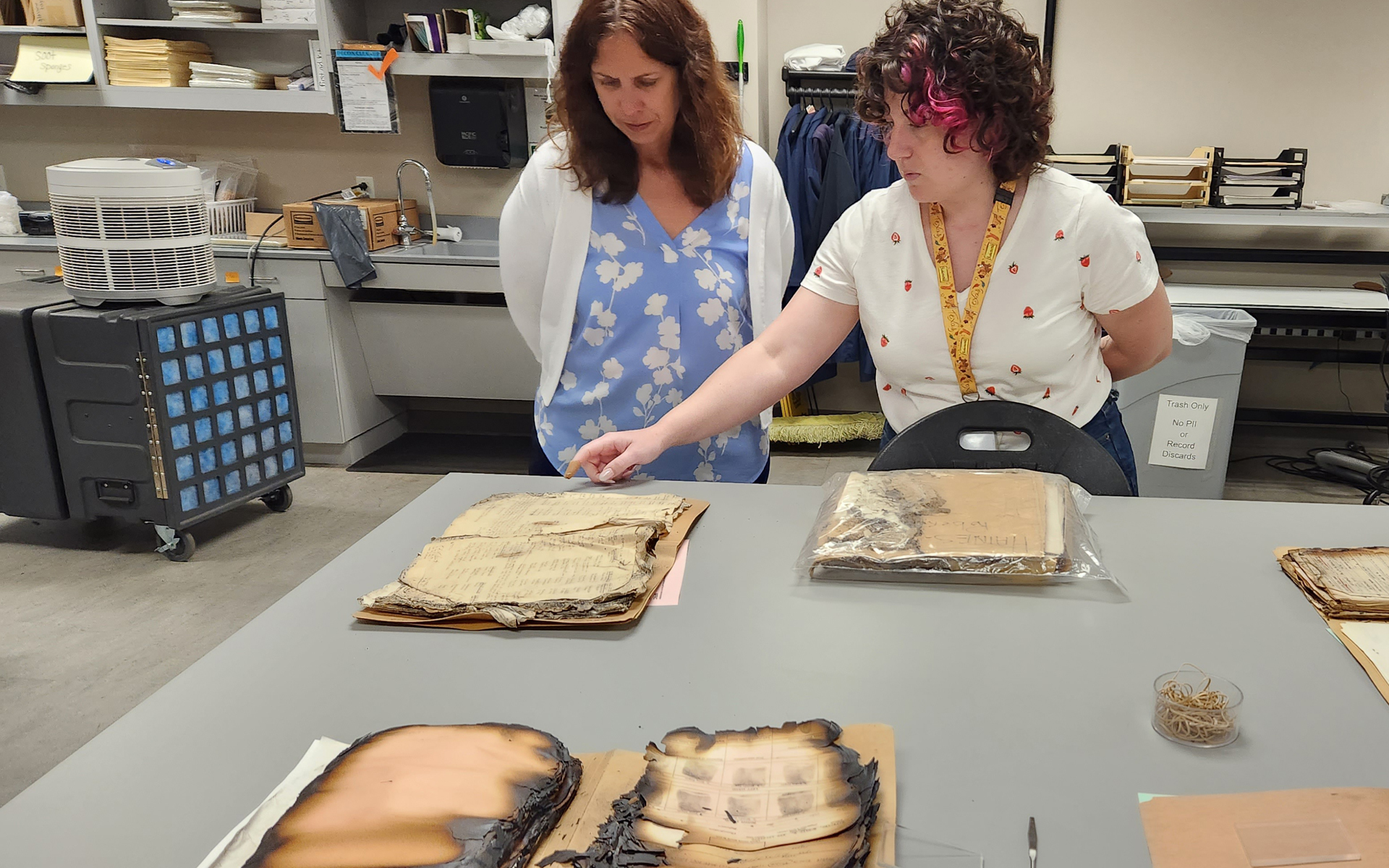
Military veteran records, for instance, are the most used records in the archives. They’re in the National Personnel Records Center right outside of St. Louis. Without access to those records and without continuous digitization of them, it’s very hard for veterans and their families to access the benefits the government promised them. If a veteran dies and the family wants to bury them in a military cemetery, they need access to the veteran’s service record to prove eligibility for that benefit. Veterans will need access to their service records if they are involved in a dispute about the level of health benefits they’re entitled to. These records allow them to show where they served and if they were exposed to risks, such as a burn pit or certain chemicals. During the COVID-19 pandemic, almost no veteran records were digitized. Following the pandemic, the backlog of veterans’ records requests soared to more than 600,000. That’s caused serious delays in veterans’ getting their benefits.
Presidential records are another important example. Access to presidential records allows journalists to put current events in a larger historical context. Five years after the conclusion of a term, presidential records must be made publicly available through the Freedom of Information Act (FOIA), according to the Presidential Records Act. So, President Trump’s records from his first term in office will be available for request beginning in 2026. Journalists often make FOIA requests to access presidential records. For example, a journalist covering international diplomacy will want to see what past administrations did in particular interactions with a country or with a particular foreign policy decision.
Access to National Archives records is also critical when there’s a new Supreme Court nominee. These nominees have often worked in the federal government in some capacity, sometimes as White House legal counsel or at the Department of Justice as an attorney. Not only will journalists want access to relevant National Archives records, but senators who sit on the Senate Judiciary Committee and who are going to vote on nominees will also need access to these records to understand the nominee’s positions and actions when they served in the federal government.
What are the dangers of politicizing the National Archives, an officially nonpartisan resource?
That is the question of the hour. Before becoming national archivist, I worked at the Congressional Research Service, the Library of Congress, and the White House Historical Association. These are all nonpartisan agencies or organizations. Their role is to provide citizens with the information they need to draw their own conclusions, to analyze and make decisions about our history, about what has happened and why. It is not the role of any of these entities to interpret history or information for citizens. They exist to provide access to documents and related resources.
If you politicize these entities in any way, you compromise that nonpartisan role of providing information and tools for thoughtful analysis. Instead, there will be a temptation to use an ideological lens in how information is presented and what information is available.
In December 2024, a group of Democrats led by Senator Kirsten Gillibrand called on President Joe Biden to add the Equal Rights Amendment (ERA) to the Constitution before he left office. Both houses of Congress had approved the amendment in 1972, but the states did not ratify it within the required seven-year time frame. Thirty-eight states (the needed threshold) have since ratified it, although some later attempted to rescind their ratifications. Gillibrand argued that the ratification deadline was unconstitutional and that Biden could instruct the national archivist to legally certify the ERA. Why did you decide to not certify the ERA as part of the US Constitution? How does that relate to what you’ve said about the dangers of politicalization?
It’s an instructive example about the nonpartisan role of the national archivist. Two different opinions—one during the first Trump administration, the second during the Biden administration—from the US Office of Legal Counsel [the Department of Justice unit that provides legal advice to the president and all executive branch agencies] agreed that the ERA had not satisfied the requirements of Article Five of the US Constitution. Several states ratified the amendment both after the deadline and after the extended deadline. Furthermore, two court cases, one at the district level and the other at the appellate level, stated that the national archivist could not certify the ERA. So, both the judicial and executive branches stated that I could not legally certify the ERA. My personal opinions about the ERA were not relevant. I took my role, and still do to this day, as a nonpartisan leader of a nonpartisan institution very seriously.
How should the public respond to the various issues and threats we’ve discussed in this interview?
They should be loud and vocal to the members of Congress who represent them. They should make their thoughts and feelings known. Whether that’s visiting a district office, attending a town hall meeting, sending emails, or making phone calls, the more members of Congress hear from constituents about what they value in a democracy, the more likely they are to make better decisions. As someone who worked for a senator, I know that when a senator starts hearing from a large number of constituents, they can’t ignore it. Or at least, they ignore it at their own peril. Don’t think, “I can’t really have a big effect. They’re not going to listen to me.” That’s not true. As someone who saw it firsthand, I know you can make your voice heard.
How can colleges and universities respond to the possible effects on higher education?
They can teach students about the importance of these records to a democracy and about the value of these institutions. Over three hundred million National Archives records are currently digitized and available online in the National Archives Catalog. Teach students how to access and use these records. Incorporate them into coursework and get students to use these primary sources in research projects and papers. This will allow students to personally experience the value of these resources. As these students mature and grow older, they’ll then be more likely to see the importance of having national libraries and museums in the US. Some of them will become policymakers and decision makers. They’ll act to protect and strengthen these resources.
Despite the challenges you’ve described, do you see signs of hope for the future?
Absolutely. I’m no longer at the National Archives, but there are still thousands of employees there, many of whom have worked there their entire careers. They’re staying because they believe in what they do. They know the importance of providing citizens in a democracy with information. For every negative story, there are thousands of positive stories about people who are employed by the federal government doing their jobs every day. Regardless of the environment, they believe in the mission.
Exclusive Content
Subscribe to unlock all issues and articles
You have reached the maximum number of free views. Please login or become a member to continue reading.