
College Radio Is Not Dead
Ignore the obituaries. College Radio is an antidote to algorithms, an educational opportunity for students, and gloriously imperfect.
⚠️ You have free article remaining.
Log in or become a member for unlimited access.
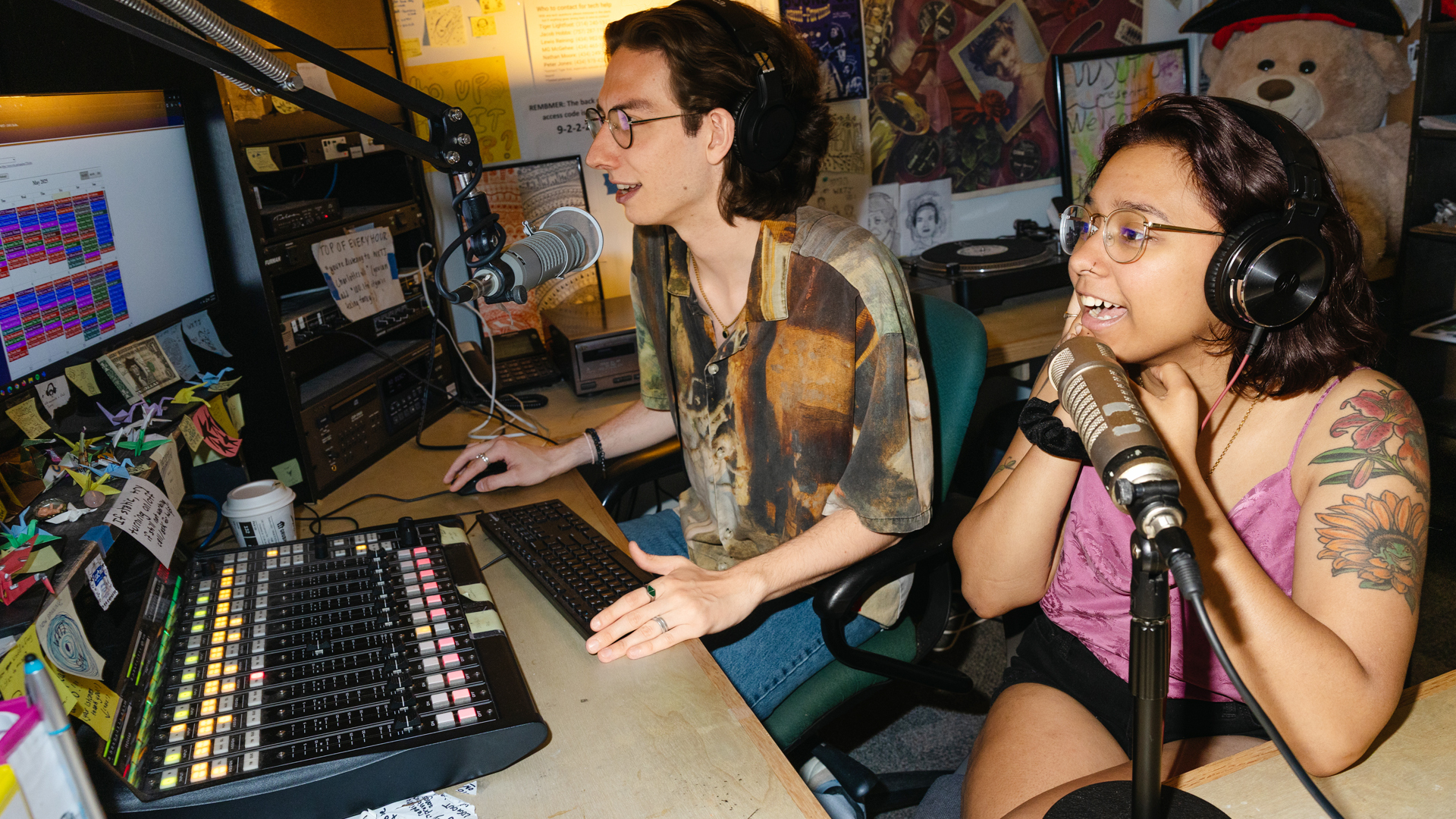
Mary Hall and Jacob Hobbs smile at each other from behind their microphones. The WXTJ studio at the University of Virginia (UVA) is dim, lit only by a string of white Christmas lights dangling across the ceiling and the glow of a computer screen that brightens Hall’s face. A big-bellied, three-foot-tall teddy bear sits on a shelf, leaning into a corner as if listening to the show; the walls are lined with posters from station-sponsored events on the Charlottesville campus. Hall and Hobbs are seniors and four-year radio vets—and the studio is clearly their happy place—but they’re still students dealing with grad school applications (he’s a computer science major, she’s a theater major, and both plan to pursue a master’s degree) and the start of spring classes (it’s their first show of 2025).
“We’re now in our last semester of undergrad,” Hall says at the start of the show.
“We’re not thinking about it. We’re not talking about it,” Hobbs says.
“We’re doing so many cool things and not thinking about May. I don’t even know the day.”
“May 17.”
Hall cringes but grins at the thought of graduation. “We’re gonna make this semester a killer one,” she says.
“Yep,” Hobbs replies. “I’m gonna fake it till I make it.”
Hall promises listeners some “banger songs,” and they begin with R&B artists Kali Uchis (“Your Teeth in My Neck”) and Jordan Ward (“FAMJAM4000”). Their nighttime show is called High Up & Low Down (Hobbs is tall, Hall is not), and for the next two hours, they will chat, chuckle, and share their love of music, or as Hobbs puts it, “inflict my musical tastes on Charlottesville.” The show leans toward R&B, but depending on their musical mood, they might play obscure tunes from iconic oldsters like The Smiths or ABBA or new tunes from groups such as funk band Vulfpeck or singer-songwriter Clairo. Their banter is easy and relaxed, a chemistry resulting not just from on-air experience but from running the station as members of its executive board. WXTJ airs around ninety different free-form shows, all of which, like High Up & Low Down, may include any number of genres, depending on the whims and whimsy of their hosts.
A similar scene is happening in studios around the country, from Michigan State University’s WDBM (twice named national college radio station of the year in the College Media Association’s Pinnacle Awards, most recently in 2024) to WSBU at western New York’s St. Bonaventure University (WSBU dates back to 1948 and was declared the nation’s top college radio station by Best College Reviews). Exact numbers are hard to find, but roughly 420 AM and FM college stations are operating in the United States, according to the website Radio-Locator.com, along with about a hundred online-only stations. In 2024, more than seven hundred radio stations in fifty-plus countries and six continents participated in World College Radio Day, an annual event hosted by the College Radio Foundation.
The goal of World College Radio Day is to raise the profile of student-run stations, since college radio can sometimes seem like, well, floppy disks. People are surprised they still exist. “When I told a friend that I would be hosting a radio show every Monday at 11 a.m. on KSUN, Sonoma State University’s student-run radio station, he looked at me almost in disbelief and said, ‘Are college radio stations even, like, a thing anymore?’ ” wrote recent graduate Ally Valiente in a September 2024 essay for the journalism organization EdSource.
College stations indeed face challenges, from increased competition (streaming services, podcasts, YouTube) to audience fragmentation and budget concerns. Most stations are funded by their colleges and universities, though some are independently operated. Budgets can vary wildly. Some large institutions may provide around $500,000 to their student stations, though most budgets are around $10,000 to $25,000, “particularly at schools where the radio station has been treated as just a student club rather than a curricular resource and cultural hub,” says Nathan Moore, a WXTJ advisor and general manager of UVA’s community station, WTJU.
Student fees are another income source. The 21,000 students at UVA, for example, each pay $3,780 in annual student fees; $10 of that goes to WTJU (the student station, WXTJ, falls under WTJU’s budget). College stations do not run paid advertising—they are classified as noncommercial by the Federal Communications Commission (FCC)—though they can accept underwriting. Most have a faculty advisor and a relationship with their campus’s student affairs office; some are integrated into communication or journalism programs. Yet despite their educational and cultural value, radio stations could be a convenient place to cut as institutions face the potential loss of federal dollars.
“The fight is to convince people—and unfortunately, those people are often college administrators—that college radio stations are precious, valuable, and a genuine outlet of free expression for their students, alumni, and the community,” says Rob Quicke, director of the W. Page Pitt School of Journalism and Mass Communications at Marshall University in West Virginia and the founder of College Radio Day. “People keep assuming that college radio might be dead or dying, or that it’s like finding an old Blockbuster or RadioShack—like, ‘Hang on, this thing is still around?’ But rumors of our death are greatly exaggerated.”
In fact, college radio is very much alive—and vital. It can include stations affiliated with National Public Radio (NPR), such as American University’s WAMU in Washington, DC, but it’s the student-run stations that are special, providing fresh voices, real-world educational opportunities, and often-eclectic programming in a world of audio sameness. Need convincing? Here’s our countdown of the top five reasons college radio is relevant.
5. You might hear Gregorian chants.
College radio is almost as old as radio itself, but its anything-goes, avoid-the-mainstream ethos emerged in the late 1960s as an alternative to staid, top-forty radio. The heyday evokes images of longhaired stoner disc jockeys eschewing the hits for jazz genius Miles Davis or sitar virtuoso Ravi Shankar, as students enjoyed freedom from commercial pressures and “a reputation for amateurism” and “experimented with new sounds to expand listeners’ minds and tastes,” writes Katherine Rye Jewell, a historian at Fitchburg State University, in her book Live from the Underground: A History of College Radio. Student DJs played cuts from under-the-radar records—not the No. 1 song on the pop charts.
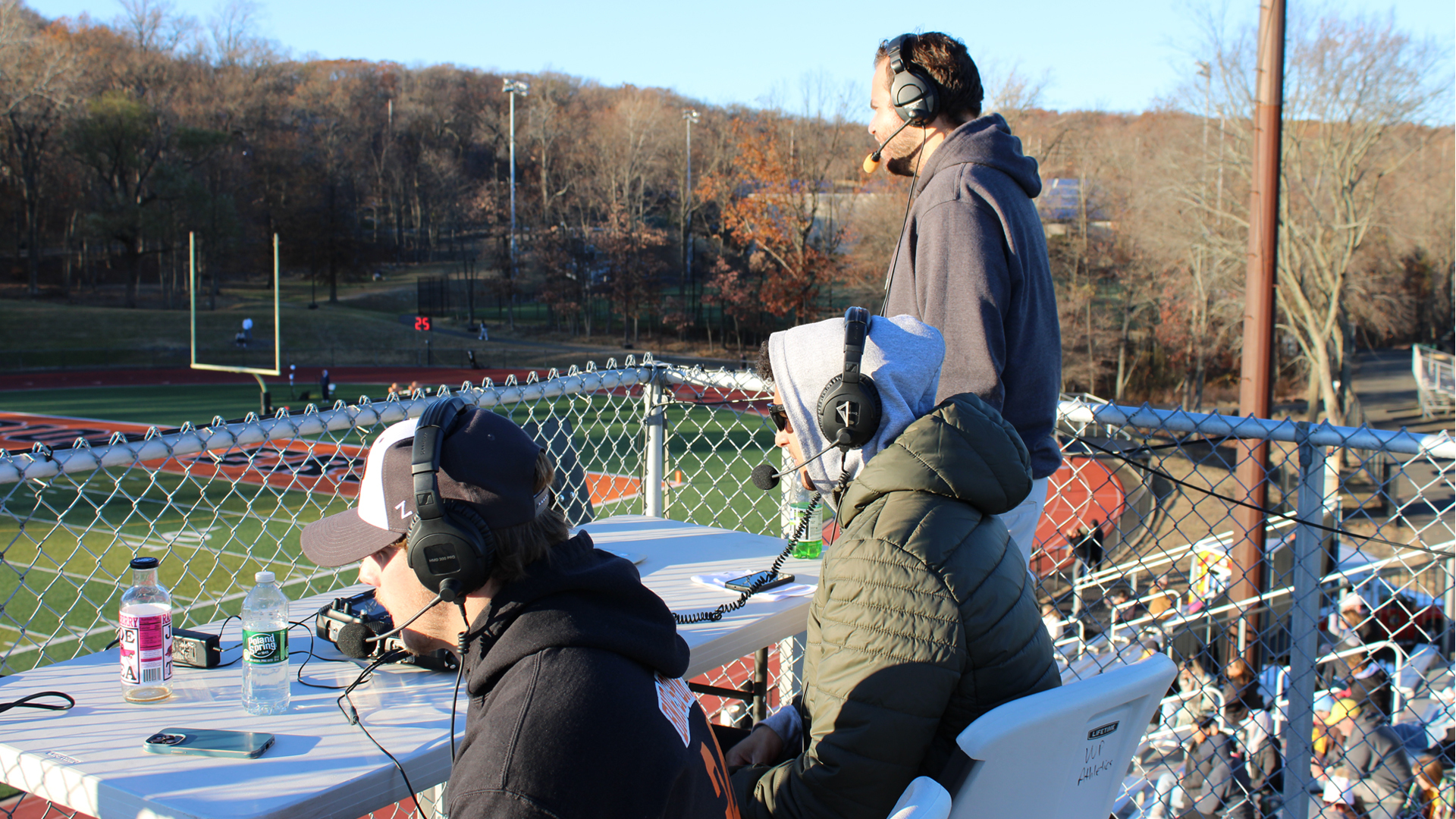
That legacy continues. Although some stations use commercial radio formats to provide training to students seeking careers in broadcasting, the play-what-you-want philosophy endures. Scan the college airwaves, and you might hear anything: R&B, techno-pop, hip-hop, classic rock, Americana—all on the same station, along with talk shows (from current events to a philosophy show on Texas State University’s KTSW) and broadcasts of school sporting events.
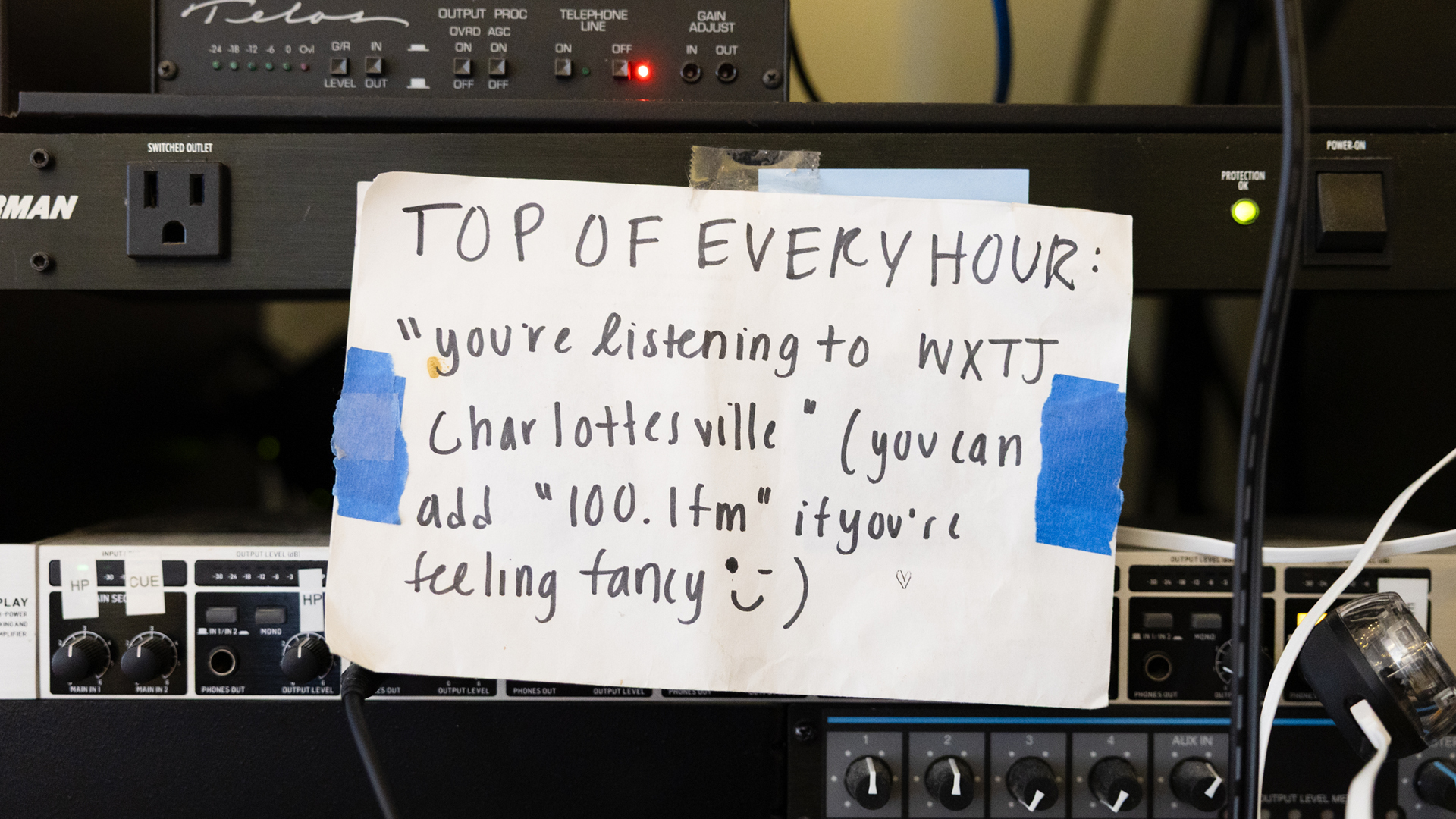
At Wayne State College in Nebraska, radio station KWSC “The Cat” focuses on numerous genres: one show might serve metal, another nineties music, another talk. Sunday morning shows can range from Mexican pop to jazz. “If you want to listen to weird stuff, tune in around 1 a.m.,” says Sean Ahern, faculty advisor for The Cat and an associate professor in the college’s Communication Arts Department. The All-Nighter airs from midnight to 5 a.m. on Mondays, Tuesdays, and Wednesdays, and features “twenty-minute songs, krautrock [experimental psychedelic avant-garde German rock from the late 1960s and early ’70s], Gregorian chants—that kind of energy,” Ahern says.
Ithaca College’s WICB in New York offers equally eclectic programming, with individual shows devoted to the Beatles, the blues, funk, punk, bluegrass (a show called Hobo’s Lullaby), and many more genres, along with talk shows such as Ithaca Now, featuring interviews with community leaders on the issues facing the city.
At UVA, students determine WXTJ’s programming. It’s “super free-form—it changes from show to show,” Moore says. “It’s fascinating to see what people play from the deep catalog. For whatever reason, Gen Zers [most current college students] still play a lot of, like, Whitney Houston or Fleetwood Mac, in addition to stuff that’s more current. They’ll play Nirvana alongside some random Japanese YouTuber they found. One time, a couple of students raided our vinyl library and played traditional Swiss folk tunes.”
Moore, Hall, and Hobbs all gush about a student DJ (recently graduated) who hosted a unique two-hour morning show. The first hour was like radio ASMR—autonomous sensory meridian response, where positive feelings and tingling are generated by hearing certain sounds—featuring “breathing and eating noodles and whispers,” Moore says. The second hour was punk and hardcore. The show’s title: Soft and Hard.
That’s the spirit of student-run radio. Yes, you may hear Taylor Swift, but you won’t hear the same song in heavy rotation, what author David Rowell, in his book The Endless Refrain: Memory, Nostalgia, and the Threat to New Music, calls “the almost sinister level of monotonous programming carried out by those who believe that repetition is what we need from music most.” And who knows? On a student station, in addition to Beyoncé you might hear Broadway show tunes. Or “King of Swing” Benny Goodman. Or yodeling. “The beauty of college radio,” Quicke says, “is that you don’t always know what you’re going to get. It serves as a platform for many underrepresented voices that you won’t hear anywhere else. It’s proudly not mainstream.”
4. Stations expose new artists to new audiences.
From the late 1970s to the early 1990s—a golden age in college radio, the College Radio Foundation has declared—student stations propelled little-known bands to mainstream popularity. The best-known success story is R.E.M., most of whose members were students at the University of Georgia when the alternative rock band formed in 1980. Around the same time, a then-unknown Irish band called U2 made appearances at college stations while traveling the United States. “The college stations were crucial to U2 becoming known in the American radio world,” U2 guitarist the Edge once told an interviewer. Numerous other groups, such as Nirvana, the B-52s, Public Enemy, the Cure, and 10,000 Maniacs, also received significant boosts from college radio.
That level of influence has passed, but college radio still provides a crucial platform for unknown artists, not simply by playing their music but through in-studio appearances and station-organized shows.
“College radio is still doing the important work of discovery, case making, sharing, and being an influencer,” Quicke says. “It’s still the place that discovers music and gives artists their first shot of being heard by an audience. College radio is there from the beginning, and often, unfortunately, we don’t get the credit, because we break the band, and then commercial radio steps in and says, ‘Hey, thanks a lot, we’ll take it from here.’ But we’re doing important work.”
The exposure can occur on a micro level. Loose Champagne is an R&B group that “has gotten so big at UVA, and one of their first shows was with us,” Hobbs says.
Hall cites a Richmond-based band called Solera. After seeing them on YouTube, she invited them to appear on Offbeat Roadhouse, which is UVA’s version of NPR’s Tiny Desk Concerts, where artists perform live in an office space at NPR’s Washington, DC, headquarters.
When Quicke was general manager of WPSC at William Paterson University in New Jersey, he and the student DJs created a special event, giving fifteen hours to fifteen Jersey artists and bands for interviews and live on-air performances.
“Not all the bands are great, but that’s the whole point of college radio,” Quicke says. One group, however, stood out. “I was one of five people in the audience, and I was like, ‘This band is really good.’ The next time I saw them was with seventy thousand people at MetLife Stadium.” The band was folk-rock superstars the Lumineers.
3. Students gain real-life experience.
Running a student station is like running a business. At UVA’s student-run and student-staffed WXTJ, anywhere from 120 to 150 students work in on- and off-air positions. They make the decisions. UVA holds the station’s license, and Moore’s job, he says, is “to make sure we’re in compliance with all the various FCC and university rules and regulations. But the student organization WXTJ Student Radio operates the station.” Moore provides advice on radio and organizational matters, but he is not listed as an official advisor to the student organization.
As station manager of Radio Mitchell in New London, Connecticut, Joshua Bar-Nadav has a wide range of responsibilities. He handles human resource issues and manages the station’s student volunteers. He’s created a station database. He’s launched a marketing program, enhanced the brand, and expanded the audience. And he’s a senior at Mitchell College.
“Jay is a great example of how the station is an opportunity for students to pursue their own interests,” says Luke Walden, a communication professor and faculty advisor to the station. “He’s a business major, and his interest is in growing the radio station as though it were a business, which it sort of is. Other students have been really interested in the communication part or the music or the tech. We support that the best we can.”
“We all love business, so we treat it like a startup,” Bar-Nadav says of himself and his colleagues.
Max Murray has a similar story. He started in 2023 as a DJ on Aggie Radio, a student-run FM station on the Utah State University campus. Now, as a junior, he’s the station manager.
“My favorite part is helping all these people who have creative ideas or visions and bringing them to life,” Murray says.
One example is student Swetha Bharat, who won the 2025 Aggie Voice competition (Utah State’s version of American Idol). Murray and the station’s engineer, Nate Jefferies, spent a day with Bharat recording her original song and working with a team to shoot a music video. The song is currently part of Aggie Radio’s regular rotation, and Bharat performed at the station’s April 2025 concert.
Like many students involved in college radio, Murray and Bar-Nadav are learning skills and gaining experience—about business, marketing, communications, writing, engineering—that they likely won’t learn in the classroom. Some will use their experience as a launching pad. Comedic singer “Weird Al” Yankovic started using his now famous name while hosting a show at California Polytechnic State University’s KCPR in the 1970s (and he recorded his first hit, a “My Sharona” parody called “My Bologna,” in the station’s bathroom). But the real-world skills that students gain will prove useful regardless of whether they pursue a career in broadcasting (many will not).
“A lot of students, when they get here, they’re like, ‘Why do we have a college radio station?’ ” Ahern says. “I say, ‘Well, it’s another opportunity for you to work on your promo and social media skills that you’re learning in your public relations class, or your interpersonal skills, or your business skills. I see it as a great learning tool for mass media and graphic design and business and all these different majors.”
2. Radio is the college experience at its best.
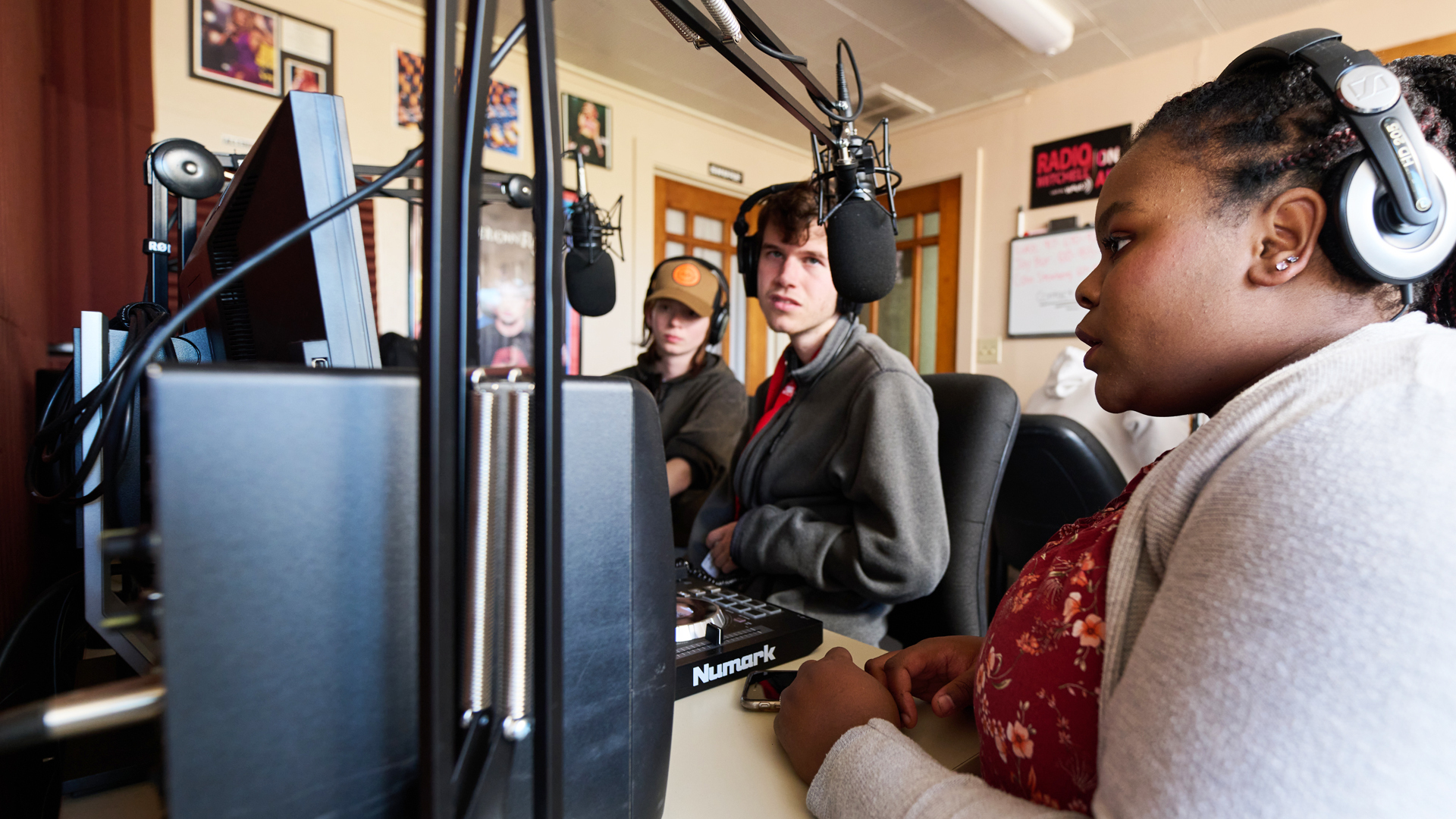
Here’s a cool thing about student-run radio: anyone can do it. It’s not like attending a hoops powerhouse like Duke University where players are recruited in junior high and thinking, “Hey, maybe I’ll try out for the basketball team.” Radio is open to everybody. You can learn. You can have fun. You can grow. “It’s a great opportunity for students to find their voice,” Ahern says. And it’s a safe space, Quicke adds, where students can find acceptance, discover their identity, and connect with peers.
“If you get involved in a college radio station as a student, you’re going to make friends,” he says. “You’re going to find a passionate community that will champion music and content and champion each other. College radio is this bastion of beautiful acceptance and inclusion, where we take anyone and everyone and we turn no one away. We have people who haven’t found a home anywhere else, but they feel safe and included at their station.”
Quicke tells the story of a female student who produced a radio documentary piece on domestic abuse and sexual assault that he calls “the most powerful piece of audio I’ve ever heard.” The piece features interviews with a series of women about their experiences—and then the student producer reveals that she was raped by her boyfriend.
“We played that in a class to twenty students or so,” Quicke recalls (when it was later broadcast on William Paterson’s WPSC, the piece included a recording of Quicke recounting the class’s reactions). “The audio finished, and it was complete silence. Everyone was stunned. And the student, she was terrified. Like, what have I done? Then she received this extraordinary outpouring of love and support. Some students were in tears. It was a remarkable moment, and there have been moments like that in my time at college radio. It can be life changing.”
1. It’s a triumph of soul over streaming.
Services like Spotify and YouTube have swallowed some of college radio’s audience, but Ahern makes a prediction: “I think people are going to get more and more sick of the stream,” he says. “I’m sick of my stream. I think people are getting tired of the algorithms and AI, and they’re going to start saying, ‘There’s this old thing on my car stereo—let’s listen to FM radio.’”
Ahern and others envision a college-radio renaissance similar to the resurgence of vinyl: the triumph of analog over digital, with its imperfect crackles and pops, and the hypnotic joy of the needle’s circular journey. Vinyl is warm and ancient and flawed, just like college radio.
“You’re going to find something with college radio that you won’t find with any algorithm, and that’s authenticity,” Quicke says. “College radio is brilliant because it is not perfect. It often has this criticism that it’s dead air and mistakes, and a bit ramshackle at times, but therein lies its beauty. Not all college radio is like that, but the priority is authentic communication over technical polish.”
And unlike the algorithm’s “if you like this you might like that” suggestions, a DJ can offer surprises. “Your algorithm is customized to you, but I love listening to all the shows because there’s always one song I’ve never heard of,” says Murray of Aggie Radio. And DJs offer another human quality: passion. When Murray told one host they’d booked her favorite band for an interview, she cried.
“When a student says, ‘Hey, listen to this song—it changed my life,’ that’s not hyperbole,” Quicke says. “They really believe in the power of college radio, because they’re at an age where they’re not jaded.”
Unlike mass media, college radio can be narrower. “We have a niche community audience,” Walden says of Radio Mitchell. “All of those millions of podcasts out there are not directly speaking to the Mitchell community about the Mitchell community. We’re looking for ways to be bigger and more relevant, but [Mitchell] is our core. That’s what’s great about college radio.”
Creating community, Moore believes, is one of college radio’s strengths. It can serve as a small yet heartwarming tool in a world that often feels harsh, divided, and cold. Hearing a DJ, he says, can make you think, “Wow. That’s a real person there.”
“People are more isolated than they’ve ever been, and social media platforms encourage that,” Moore says. “We need institutions where you can just be human and you can feel connected and heard and understood. And that, fundamentally, is what stations like this are about. It’s a space for people to come together and be an actual community that cares about each other. As long as we’re serving people’s real needs, I think we will continue to be relevant, and continue to survive, and even thrive.”
Lead photograph by Tom Daly
Another Form of Radio
Student-created podcasts are enriching broadcast content
Before she graduated from Arcadia University in May 2024, Jo Creollo had a goal: she wanted to host a podcast. She pursued the idea for her senior thesis project (Creollo ultimately earned a bachelor of arts degree in media and communication) and sought help from the Pennsylvania university’s student-run online radio station, which provided training and access to its studio. Her podcast topic: crisis-management case studies. “[The subject] sounds so boring to a lot of people,” she wrote in a student blog, “but it was so fun to record regardless.”
Podcasts may seem like competition for college radio—the web is teeming with as many as 4.4 million podcasts, according to Podcast Index—but many stations are embracing them. In March 2024, Randolph-Macon College in Virginia dedicated the Jacobs Radio and Podcast Studio for both its online station and a podcasting class in the communication program. When Utah State University built a new studio for its student station, Aggie Radio, it also built a podcast studio. The station produced zero podcasts in 2024, but during the spring 2025 semester (the studios opened in January) it produced ten. Podcast topics include books, movies, animals, food, campus organizations, sports, and Greek life. Any student can use the podcast studio after completing a training process and receiving approval from the Aggie Radio board, with listeners accessing content through mainstream podcast services like Spotify and Apple. “Podcasting is not to be feared,” says Rob Quicke, director of the W. Page Pitt School of Journalism and Mass Communications at Marshall University in West Virginia and the founder of College Radio Day. “The best college radio stations recognize that podcasting is a form of radio and either take their content from their shows and put it into podcasting or integrate podcasting into what they’re doing as a form of their content production. It’s another way to get content out there.”
Student News Live
A new platform allows college journalists to develop in-depth content for their peers
If you get your news from CNN, Fox News, or MSNBC, you’re probably, well, old. The median age for those networks: 67 (CNN), 68 (Fox News), and 71 (MSNBC), the Los Angeles Times reported before the 2024 presidential election. “The younger generation often feels ignored, and they certainly felt disenfranchised about the election,” says Rob Quicke, director of the W. Page Pitt School of Journalism and Mass Communications at Marshall University in West Virginia and the founder of College Radio Day. The desire for a more youth-based perspective is one reason the College Radio Foundation launched Student News Live, a student-led news network, in September 2024. Its mission: to provide a platform for student journalists and to showcase diverse voices, perspectives, and experiences. On Election Day 2024, students at a hundred-plus institutions aired twenty-four hours of continuous television coverage from a student perspective. Content was shared via individual campus media sites, along with other outlets such as social media channels and streaming platforms. Since the election, Student News Live has continued its deep news coverage. In December 2024, the network published an interview with Jonathan Gruber, chair of the Economics Department at the Massachusetts Institute of Technology and an architect of the Affordable Care Act. And in February, the network hosted a live town hall with the Reverend Al Sharpton for Black History Month.
Exclusive Content
Subscribe to unlock all issues and articles
You have reached the maximum number of free views. Please login or become a member to continue reading.